Erfolgsbilanz
30 Jahre Arbeit auf Tausenden Quadratmeilen.
Die gute Nachricht: Die Erneuerung von Landschaften und Regionen ist nichts Neues. Sie ist vielfach erfolgreich erprobt und in vielen Teilen der Welt bereits im Gange. Mitglieder unseres Teams haben über Jahrzehnte gemeinschaftlich getragene Initiativen zur ökologischen Wiederherstellung und Landpflege auf Millionen von Acres konzipiert, umgesetzt und überwacht.
Gut dokumentierte Beispiele sind die Malpai Borderlands im amerikanischen Südwesten, die Blackfoot Challenge in Montana und die Wiederbelebung der Fischerei an der Küste von Maine, dazu zahlreiche weitere Initiativen weltweit. Diese Erfahrungen zeigen, dass Erneuerung auf Landschaftsebene kein bloßes Ziel ist, sondern ein bewährter Ansatz, der dauerhaften ökologischen, wirtschaftlichen und gesellschaftlichen Nutzen bringt.

Malpai Borderlands
Südliches New Mexico1.000.000 Acres · 2 Länder · 4 Bundesstaaten · 8 Countys · 30+ Jahre (laufend)
Eines der am intensivsten untersuchten landschaftsweiten ökologischen Projekte, in einem ähnlichen Biom und ökologischen Kontext wie das aktuelle NM-Pilotprojekt. Die Achillesferse des Projekts, die Abhängigkeit von staatlicher und Stiftungsfinanzierung, die nach der Finanzkrise von 2008 zusammenbrach, ist genau das, was die Architektur der Transformationsfazilität löst.
Warner Glenn und Kelly Glenn, Rancher; Richard Knight, Colorado State University. Curtin, C.G. (2015), begutachtetes Buch, das das Projekt dokumentiert
Blackfoot Challenge
Westliches Montana2.200.000 Acres · Wassereinzugsübergreifende Kooperation · Über Jahrzehnte
Ein weltbekanntes Forellengewässer und Einzugsgebiet, in dem hohe Bodenwerte den wirtschaftlichen Nutzen ökologischer Integrität auf Landschaftsebene widerspiegeln. Das Beispiel zeigt auch, wie wichtig die Einbindung der Gemeinschaft und eine sorgfältige Dokumentation sind, um die kulturellen und ökologischen Funktionen zu erhalten, auf denen die natürlichen und wirtschaftlichen Werte der Region beruhen.
Charles Curtin, vergleichender Entwurf und Monitoring. Curtin, C.G., begutachtetes Buch, das Malpai Borderlands und Blackfoot Challenge vergleicht
Downeast Initiative
Gulf of Maine, Downeast Maine7.500 Quadratmeilen · Küstennahe Grundfisch- und Hummerfischerei · Seit 2001 (laufend)
Die Downeast Initiative arbeitet seit 2001 daran, die Grundfisch- und Hummerfischerei in einer 7.500 Quadratmeilen großen Küstenregion wiederzubeleben. Ähnlich wie die Landschaften des Westens haben küstennahe Fischgründe Becken, Täler und Berge, deren höchste als Inseln an die Oberfläche treten. Es gelten dieselben Muster der Ressourcennutzung, der Fülle und der gemeinsamen Pflege, was zeigt, dass diese Prozesse in nassen wie trockenen Ökosystemen allgegenwärtig sind.
Charles Curtin, Mitgründer und wissenschaftlicher Berater, mit Jim Wilson von der University of Maine, den Fischereischützern Robin Alden und Ted Ames sowie Reverend Ted HoskinsBücher
“My books explore the intersection of ecology and culture and have focused on how the world's messiness leads to uncertainty and unexpected outcomes…and what to do about it.”
The Science of Open Spaces
Island Press, 2015
This book focuses on landscape conservation as a metaphor for addressing large, complex challenges at the junction of ecology and culture.
“The book offers both inspiration and guidance. It shows that conservation - essentially, sustainability - can indeed be accomplished.”
Complex Ecology: Foundational Perspectives on Dynamic Approaches to Ecology and Conservation
Cambridge University Press, 2018
This book takes a deep dive into the foundations of complexity-based approaches to ecology and conservation, including input from more than 60 of the leading voices from across the globe.
“Complex Ecology provides an essential compass for scientists and conservationists to navigate the shifting ecological context of conservation action.”
Place-Based Solutions: The Power of Regenerative Thinking in the Face of Crisis
Johns Hopkins University Press, 2026
The point is to move beyond the resilience framing of societal challenges that largely sustain the status quo.
“Science and technology can identify environmental threats, but don’t solve them.”Artikel und Berichte
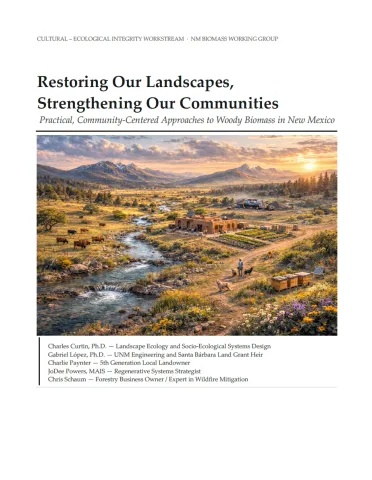
Restoring Our Landscapes, Strengthening Our Communities: Practical, Community-Centered Approaches to Woody Biomass in New Mexico
NM Biomass Working Group
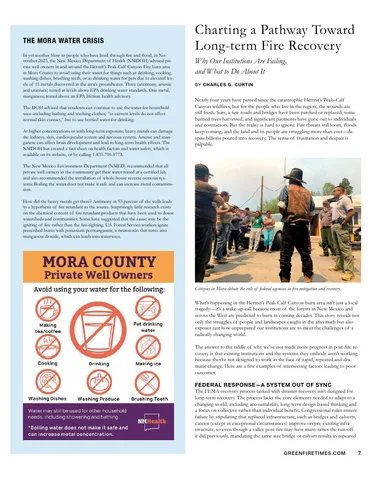
Charting a Pathway Toward Long-term Fire Recovery: Why Our Institutions Are Failing, and What to Do About It
Charles G. Curtin, Green Fire Times, January/February 2026
“The answer to the riddle of why we’ve not made more progress in post-fire recovery is that existing institutions and the systems they embody aren’t working because they’re not designed to work in the face of rapid, repeated and dramatic change.”
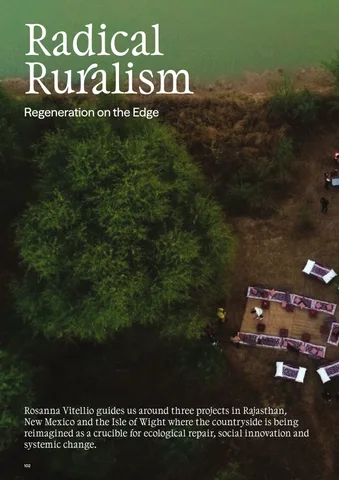
Radical Ruralism: Regeneration on the Edge
Rosanna Vitello, The Place Bureau, Meander magazine, 2025
“Author, activist and scientist Charles Curtin is confronting a landscape increasingly defined by fire.”
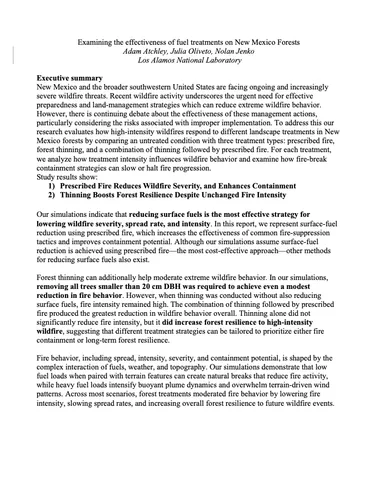
Examining the Effectiveness of Fuel Treatments on New Mexico Forests
Adam Atchley, Julia Oliveto, Nolan Jenko, Los Alamos National Laboratory
“Our simulations indicate that reducing surface fuels is the most effective strategy for lowering wildfire severity, spread rate, and intensity.”
DOCX
Quantification of the Thinning Impact on Carbon Balance and Fire Risks for Ponderosa Pine Forests in New Mexico
Chonggang Xu, Adam Atchley, Zachary Robbins, Julia Oliveto, Alex Jonko, Los Alamos National Laboratory, 2023
“A common practice in forest management is to thin forest in order to reduce the fire risks; however, because the trees that are thinned are typically small and of little economic values, they are generally pile burned.”
Beyond Firesheds: Fireshed-Watershed-Foodshed, Reenvisioning Agriculture in the Face of Climate Change
Charles Curtin, edible New Mexico, Spring 2024
“The Pyrocene has arrived, where a warming and drying climate leads to repeated larger and hotter fires.”
Biomass Energy in the Urban-Rural Interface, Sangre de Cristo Mountains, New Mexico
Charles Curtin, Forest Service Wood Innovation Grant Report, July 2024
“Creating carbon-negative markets to support landscape restoration and renewal is a crucial facet of wildfire mitigation and recovery.”
Fire, Power and Privilege in the Pyrocene
Charles Curtin, op-ed, 2023
“The Southwest has passed a climatic threshold where recurrent wildfire is not just a possibility—it’s a near certainty.”
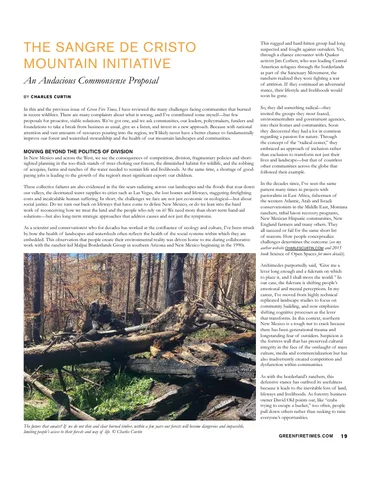
The Sangre de Cristo Mountain Initiative: An Audacious Commonsense Proposal
Charles Curtin, Green Fire Times, November/December 2022
“We need more than short-term band-aid solutions—but also long-term strategic approaches that address causes and not just the symptoms.”
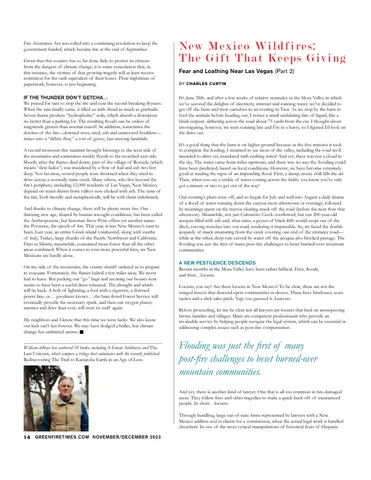
New Mexico Wildfires: The Gift That Keeps Giving
Fear and Loathing Near Las Vegas (Part 2). Charles Curtin, Green Fire Times, November/December 2022
“The water came from miles upstream, and there was no way the flooding could have been predicted, based on local conditions.”
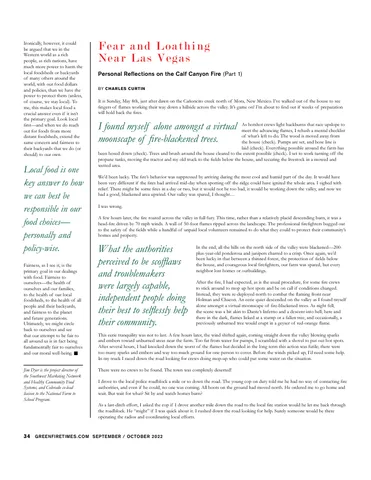
Fear and Loathing Near Las Vegas
Personal Reflections on the Calf Canyon Fire (Part 1). Charles Curtin, Green Fire Times, September/October 2022
“It is Sunday, May 8th, just after dawn on the Cañoncito creek north of Mora, New Mexico.”
Mora County Biomass Energy Feasibility Study
Sangre de Cristo Initiative, 2021